






 Trap
 Normal
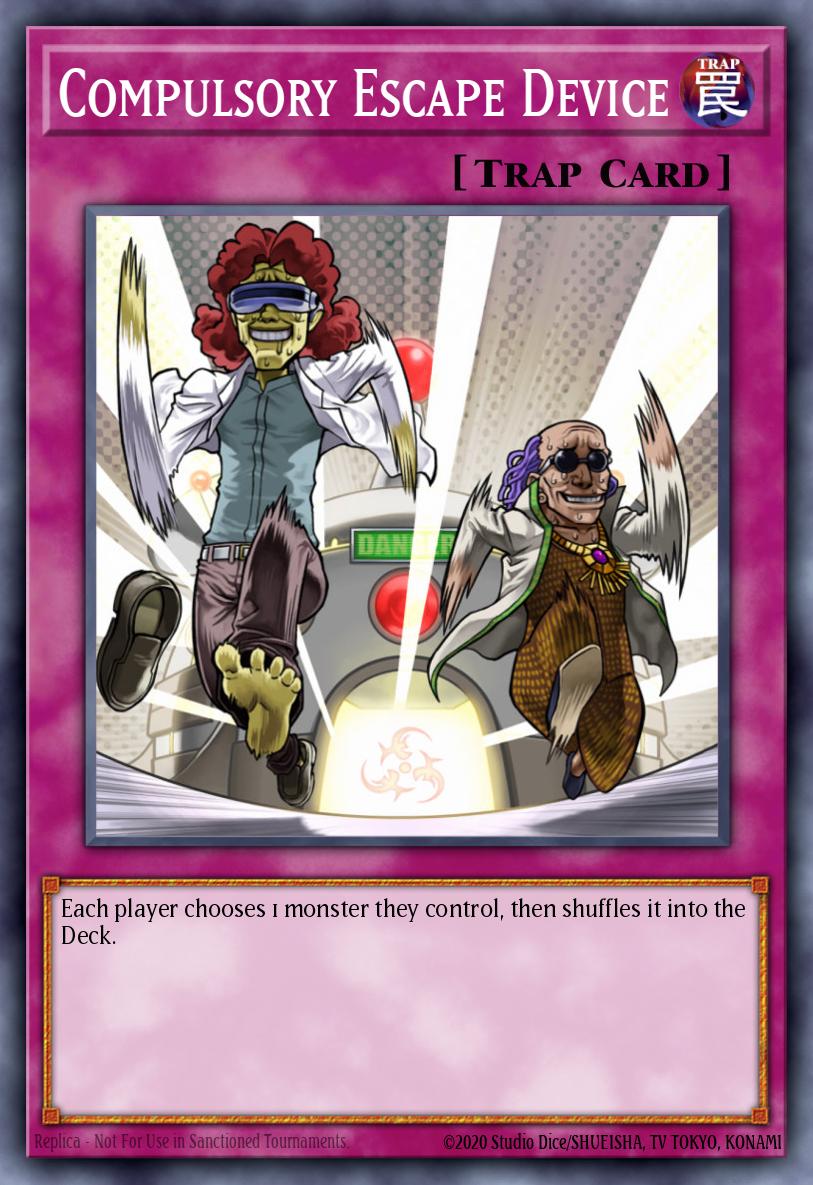
Compulsory Escape Device
View:
3652
Each player chooses 1 monster they control, then shuffles it into the Deck.
Compulsory Escape Device — Power Evaluation
Final Score: 50 ± 8 · Confidence: Medium
- Intrinsic: 48.7 · Deck: 50.7 · Meta: provisional
- Primary role: Utility · Secondary: Negation/Interaction
Why it scores here
Compulsory Escape Device is a generic Trap that lets each player return one of their own monsters to the Deck, so its value is as a cheap way to dodge targeted or destructive effects rather than as card advantage. It is run in 42 sampled decks across 26 archetypes at about 1.5 copies per deck, which confirms it is a practical staple, but that breadth reflects its generic utility and does not by itself raise its power. The score stays moderate because the card produces no advantage, has no recorded combo role, and cannot function as material. High deck counts were not allowed to inflate the result.
Axis scores
| Axis | Score | Evidence |
|---|---|---|
| Accessibility | 55 | Trap that must be set and survive to be used; it is run in 42 of 400 sampled decks but has no recorded starter or search route (observed/inferred). |
| Combo & Conversion | 20 | Text-only inference: the card builds no board and recorded combos show zero appearances (verified text, inferred conversion). |
| Resource Economy | 30 | Returns the player's own monster to the Deck with no draw, search, or recursion, so the net advantage is roughly neutral (verified text, inferred). |
| Effect & Interaction | 45 | Protective self-shuffle that can dodge targeted or destructive effects, but it does not negate or remove the opponent's cards (verified text, inferred). |
| Material Utility | 10 | A Trap cannot serve as material and only returns a monster from the field, so this axis is near zero (verified text). |
| Resilience & Flexibility | 45 | Fragile as a set Trap and can be interrupted, though it is useful across several archetypes and turns (inferred, observed deck spread). |
| Deck-Building Efficiency | 70 | Low-cost, one-to-three-copy Trap slot with no garnets or locks, so it is cheap to run (observed copies_per_deck, verified text). |
Calculation
Weight profile: 0.7 Utility + 0.3 Negation/Interaction. Intrinsic ≈ 48.7, Deck ≈ 50.7, Meta = provisional. Modifiers: none. Final formula: 0.40*Intrinsic + 0.60*Deck
Strengths
- Cheap, flexible self-protection against targeted or destructive effects
- Runs across 26 archetypes, showing a broad home base
- Low garnet and lock cost, so it fits many decks
Weaknesses
- Generates no card advantage or board presence
- Its value depends on setting it and having a monster to protect
- Cannot be used as material and does not disrupt the opponent directly
Counters / choke points
- Trap negation effects that can shut down a set Trap
- Opponent effects that avoid monster targeting or destruction, making the card irrelevant
Best use
Protective Trap to dodge targeted or destructive effects in a control or midrange shell. Decks: Traptrix, Live☆Twin, Shark, Elemental Heros, Infernoble Knight, Sinful Spoils, Fire King, Altergeist, Tech Genus, Wind-Up. Suggested copies: 1.
Evidence & gaps
- Verified: Text: each player chooses 1 monster they control and shuffles it into the Deck; Formats: TCG, OCG, MasterDuel, DuelLinks; Copies per deck avg 1.55 across 42 decks
- Observed: Runs in 42 sampled decks across 26 archetypes; Top partners include Solemn Judgment and Compulsory Evacuation Device (33% co-occurrence); Appears in 5 guides, mostly as a Tech or Trap staple
- Inferred: Acts as protective self-shuffle that dodges targeted or destructive effects; Low card advantage and roughly neutral resource economy; Fragile as a set Trap but broadly usable across archetypes
- Data gaps: no combos supplied — combo conversion is text-only inference no banlist token — assumed 3 copies (unlimited) no usage statistics (StatisticsCard) — archetype inclusion % inferred from deck sample only no rulings or interaction data for set-Trap survival or negation